Uncategorized

Bankruptcy, Shame, Second Chances: How to Get Back to Life After Wiping Out Your Bank Account

There's a moment in trading that no one wants to experience, but many end up there: you look at your account and see practically zero. Not a "bad month." Not a "loss streak." Just a brutal bankruptcy. The worst part is that you rarely go bankrupt yourself. Your household budget, your plans, and your partner's sense of security all come crashing down with you. In studies of families affected by […]


Bankruptcy, Shame, Second Chances: How to Get Back to Life After Wiping Out Your Bankroll Learn More »

When Trading Brings the House Down: How to Regain Your Partner's Trust After Big Losses

Let me be honest: the worst isn't the red score on your bank account, it's that moment when you get home, look your partner in the eye, and know you've lied to them again. The market took your money, but you gave back something more – trust, a sense of security, peace in your home. I've been there. Big losses, trying to figure out how to use credit cards, "quick loans,"

When Trading Brings the House Down: How to Regain Your Partner's Trust After Big Losses Learn more »

Trading and Burnout – How to Recognize If You're Spending Too Much Time on Charts and What to Do About It

Trading and burnout often go hand in hand – especially when you spend hours poring over charts, tracking every tick, and feeling like you "have to be constantly on the market" or you'll miss something. 1. What is burnout in trading? Trader burnout is a state of physical, mental, and emotional exhaustion that occurs after a long period of time

Trading and Burnout – How to Recognize If You've Been Staring at Charts Too Long and What to Do About It Learn More »

After a Losing Streak: How to Get Back in the Game Without Market Revenge and Stupid Decisions

Introduction – revenge trading is a fact, not an accident. You've lost three trades in a row. Your balance has dropped by 5%, and you're sitting there staring at the screen with the feeling that "I have to make up for it now." One thought in your head: get into something, any way, to make a quick return. This is what's called revenge trading – emotional, impulsive trades just for the sake of it

After a Losing Streak: How to Get Back in the Game Without Market Revenge and Stupid Decisions Learn More »

How to Deal with Stress While Charting – 5 Practical Steps That Really Work

Introduction – Trader Stress Is a Fact, Not a Weakness. You're sitting in front of a chart, looking at a position you opened half an hour ago. The price is going in the wrong direction. Your heart is pounding, your hands are sweating, and your mind is racing about how much you've already lost. This isn't a weakness. It's physiology. A trader's brain reacts exactly like this during market stress

How to Deal with Stress with a Chart – 5 Practical Steps That Really Work Learn more »

Trading Methodology and Analysis – Build Your Trading System

Introduction: Imagine a trader who enters every trade without a plan, relying on gut instinct and the hope that the market will move in the right direction. Does he make money? Sometimes, yes. But does he make money consistently? Almost never. Now imagine a different trader—one who has a clear methodology, knows exactly what to look for on the chart, knows his entry rules, and

Trading Methodology and Analysis – Build Your Trading System Learn more »

Personal Discipline in Trading – The Key to Consistent Results

Introduction: Imagine two traders. Both have the same strategy, the same capital, the same tools. One makes consistent profits. The second time, they win big, the second time, they lose everything. The difference? Personal discipline. Not strategy, not analysis, not even luck – simply the ability to stick to a plan when emotions scream "do something different."​ It's discipline that separates professionals from gamblers with pretty faces

Personal Discipline in Trading – The Key to Consistent Results Learn more »

Practical Trading Education

Practical trading isn't just another "magic course," but rather a calm, thoughtful process of figuring out a few simple things: how you make decisions, how you react to losses, and how you learn from your mistakes. And that's exactly what this article is about—especially for beginners. 1. Why so many beginners go in circles. Most people start

Practical Trading Education Learn more »

Risk Management Strategies

Introduction: Do you know the difference between a trader who survives a market crash and one who loses their entire investment on one bad day? Risk management. That unglamorous word—"risk management"—sounds boring, but it's what separates winners from losers in the stock market. In fact, research shows that risk management is the most important element

Risk Management Strategies Learn more »

Fundamentals of Trading Psychology

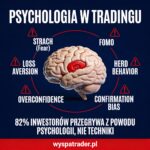
Introduction: Did you know that over 70% of investment decisions are made based on emotion, not rational analysis? It's a sad reality in the trading world, but there's also good news – psychology can be trained and mastered, just like any other skill. Trading psychology isn't some mysterious magic – it's a simple understanding of how your brain works and how

Fundamentals of Trading Psychology Learn more »

Trading Psychology: Why Your Brain Is Your Worst Enemy in the Stock Market

I'm 48 years old. I work full-time. I've been making money in the stock market for some time now. But it wasn't always this easy. Three years ago, I lost 12,000 PLN in just six months. I was completely devastated. I started searching for answers: Maybe it's a problem with my strategy? Maybe I chose the wrong broker? Maybe I need a more complex system? No. No. And again, no.

Trading Psychology: Why Your Brain Is Your Worst Enemy in the Stock Market Learn more »