The Bermuda Triangle of Your Wallet: Fear, Greed, and FOMO. How to Avoid Being Devoured by the Sharks of Your Mind
Imagine your brain isn't a supercomputer, but an ancient ship that has evolved over millions of years to survive on the savannah, not the stock market. When you sit down to read charts, you're venturing into waters your biology isn't designed for.
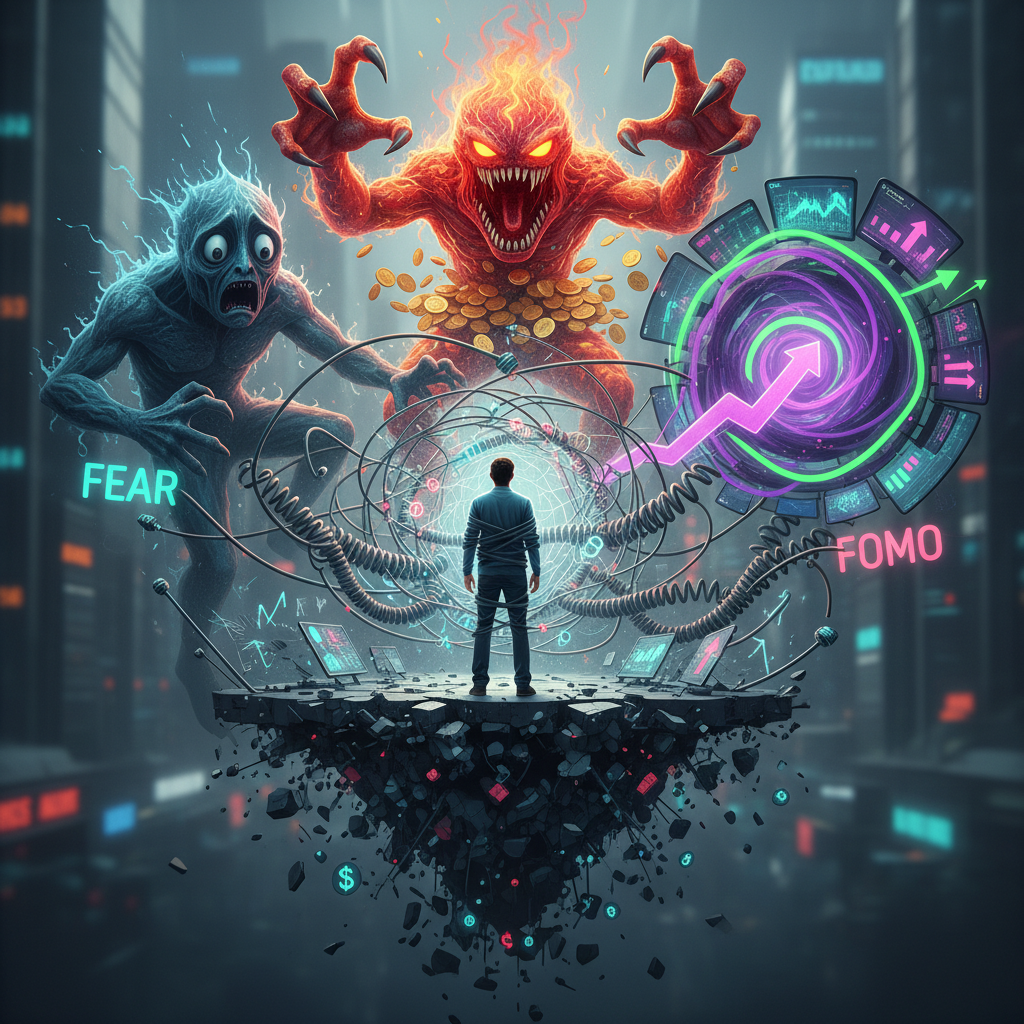
Most trading accounts don't disappear because of a bad strategy. They disappear because they fall into the psychological Bermuda Triangle . This is where logic stops working and your brain chemistry takes over.
Here's what science says about the three forces that want to sink your capital—and how to scientifically "hack" your mind to survive.
1. Fear: Why does the pain of loss paralyze the captain?
In trading, fear has a specific scientific name: Loss Aversion .
This concept was popularized by Nobel Prize winners Daniel Kahneman and Amos Tversky. Their research (Prospect Theory) demonstrated a brutal truth: the pain of losing 1,000 złoty is psychologically twice as intense as the joy of gaining the same amount.
What happens in your brain?
When things don't go your way, the amygdala —the primitive part of the brain responsible for the "fight or flight" response—is activated. It's the same mechanism that caused your ancestors to flee from a tiger.
The result? The prefrontal cortex (responsible for logic and planning) is "shut down." You stop thinking. Therefore:
You close profitable positions too early (to escape the tension).
You hold onto losses indefinitely (because closing a loss is a physical pain for the brain that it wants to avoid).
Rescue: Your amygdala doesn't understand math. The only way to calm it is through automation . A stop loss set before entering a trade is the only time your logic, not your fear, rules.
2. Greed: The Dopamine Trap and the "Casino Money Effect"
Have you won several times in a row? Feeling invincible? Be careful. You're falling into a trap known in psychology as the House Money Effect .
Research by Richards Thaler and Eric Johnson shows that after a series of profits, investors become inclined to take irrationally high risks. Why? Because the brain treats winnings as "someone else's money," it's easier to gamble with them.
What happens in your brain?
A series of gains floods your reward system with dopamine . This is the same neurotransmitter responsible for addiction. Dopamine makes you feel euphoric and… blinds you to threats. Your brain literally ignores the warning signs on the graph, focusing only on the potential reward.
The solution: When you feel like a "Market God" after a string of profits, it's a biological signal to step away from the computer. Return when your dopamine levels have subsided and you're once again focusing on risk, not just profit.
3. FOMO: Why does the crowd drag you down?
FOMO ( Fear of Missing Out ) isn't a millennial invention. It's a deeply ingrained herd instinct. From an evolutionary perspective, separating from the tribe meant death.
Neuroimaging studies have revealed something shocking: social exclusion (the feeling that others are making money and you aren't) activates the same areas of the brain as physical pain.
When you see Bitcoin rising and you're out of position, your brain literally "hurts." To numb the pain, you buy at the very top. Just to feel the relief of belonging to a group.
What's going on in your brain?
Social Proof is at work . Your mind assumes, "If everyone else is buying, they must know something I don't." You ignore your own analysis in favor of herd behavior.
The solution: Understand that FOMO is a hallucination. The market isn't a train that leaves once a day. It's a subway – the next train (opportunity) arrives in 10 minutes. If you feel pain from being out of position, it's a sign that your ego, not your wallet, is making the decision.
Summary: Switch in the Head
You can't eliminate emotions—they're part of your biology. But you can change how you respond to them.
Psychologist Daniel Kahneman divides thinking into two systems:
System 1: Fast, emotional, automatic (This is what screams: "Buy now!", "Run!").
System 2: Slow, logical, tiring (He calculates the risk and checks the strategy).
Most traders lose money because they trade System 1.
Your job is to make System 2 work. How? Through tedious procedures: checklists, trading journals, and rigid risk rules.
In the ocean of markets, it is not those who do not feel fear who survive, but those who, despite fear, stick to the map.