I'm 48 years old. I work full-time. I've been making money in the stock market for some time. But it wasn't always this easy. Three years ago, I lost PLN 12,000 in just six months. I was completely devastated. I started searching for answers: Maybe it's a problem with my strategy? Maybe I chose the wrong broker? Maybe I need a more complex system? No. No. And again, no. The truth was much more painful: the problem was in my brain. I started reading about behavioral finance. I discovered the work of scientists who studied investors around the world. Their conclusions were shocking and yet obvious: 82% of investors lose in the stock market not because they don't know the technique. They lose because they can't control their emotions. That was my aha moment. Everything changed. From that moment on, I started trading differently. I didn't draw new lines on charts. I didn't search for a new system. I simply learned to read my head. The next month, I was making +PLN 5,000. The month after that, +PLN 7,000. Now, it's normal for me. But it's not a magic formula. It's discipline and self-awareness. That's why I'm writing this article. I want to show you what I've discovered—not so you can make money quickly, but so you can make money consistently and stress-free.
For years, we thought financial markets operated rationally. That people made decisions based on facts and figures. Wrong. In 2002, Daniel Kahneman received the Nobel Prize in Economics for his research showing that people make irrational decisions. His work showed that emotions are immediately more important than logic. Later, Professor Piotr Zielonka from the University of Warsaw conducted research on Polish investors. He discovered exactly the same thing: psychology determines whether you make a profit or lose. Other important studies include Shefrin & Statman's work on "loss aversion," Hersh Shefrain's concept of "behavioral finance," and Joseph LeDoux's research on the neuroscience of fear and the amygdala. All of these studies pointed to one thing: your brain is hardwired to lose in the stock market. It's not your fault. It's biology.
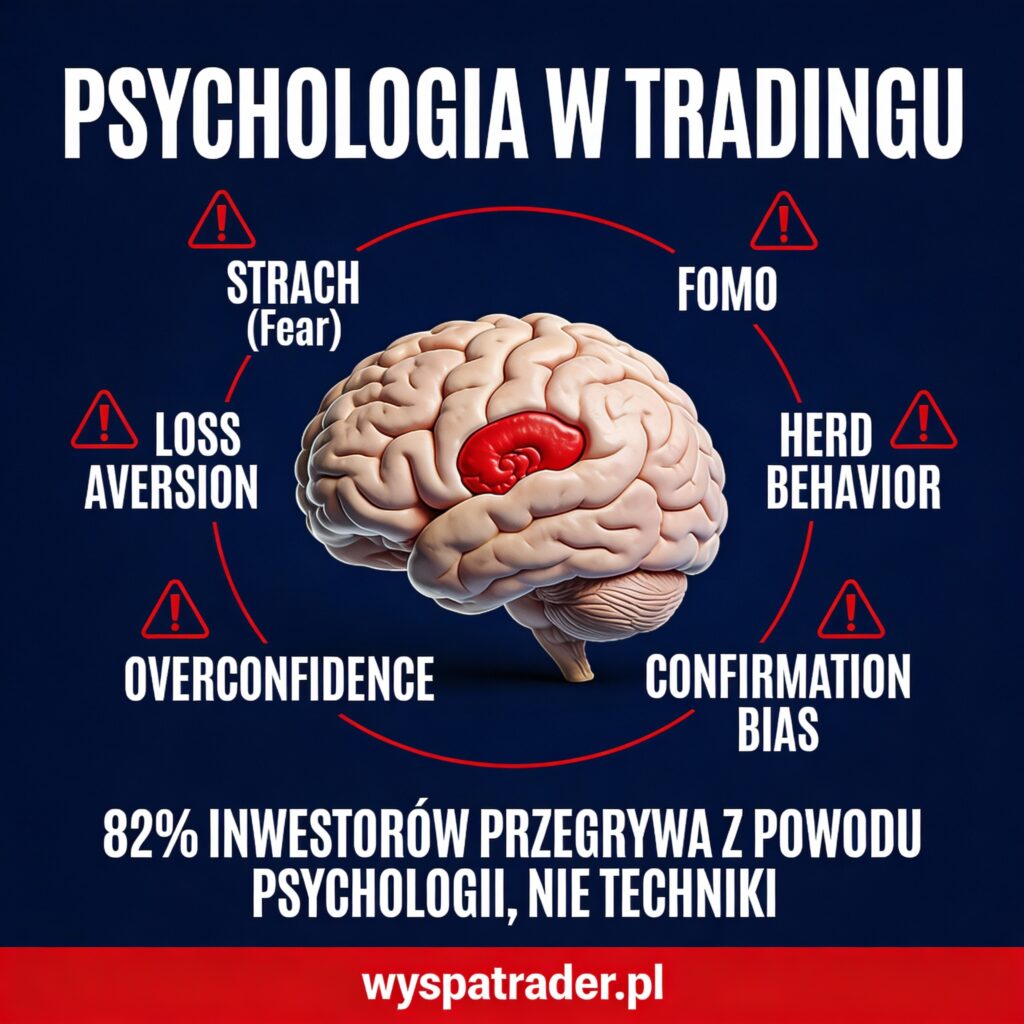
The number one threat is fear, which is governed by the amygdala. The amygdala is a small, almond-sized part of the brain located deep within the brain. Its function is to protect us from threats. When you see a threat, for example, a tiger, the amygdala immediately sends a signal: run! That's a good thing when you're fighting a tiger. It's a bad thing when you're trading on the stock market. Why? When you see your position falling, for example, a stock has dropped from PLN 100 to PLN 95, the amygdala takes over. At that moment, your rational part of the brain, called the prefrontal cortex, shuts down, fight-or-flight mode kicks in, and you panic. The result? You close the position too early because your brain thinks you're fleeing the battlefield. A real-life example: you bought a stock for PLN 100. You did your analysis. You knew it was a good five-year investment. But today, the stock drops to PLN 95. The amygdala says: run! That's danger! You close at 95 PLN, taking a loss of -5 PLN. The next day, the stock rises to 150 PLN. You were sitting on -5 PLN, but you could have made +50 PLN. All because of fear in the brain. Scientists have calculated that fear drives 40% of investors' financial decisions. Not logic. Not analysis. Fear.
Threat number two is FOMO, or Fear of Missing Out. It's a psychological mechanism that makes you irrationally want to be where others are. Scientists studied people during speculative bubbles like the crypto bubble in 2017, the Tulip bubble in 1637, and the Dot-com bubble in 2000. They discovered something terrifying: people know the price is overpriced. But they still buy in, because everyone else is. The thought is: If I don't buy in now, I'll be stupid. Everyone's making money, and I'm not. The result is buying at the top, which is the worst possible price, selling at the bottom, which is the worst possible price, and losing as much as possible. A real-world example: Bitcoin in 2017 was $1,000, everyone said it would hit $10,000, and you waited. The price rose to $5,000, everyone said it would hit $20,000, and you waited. The price rose to $15,000. Everyone was talking about Bitcoin, Bitcoin, Bitcoin! You, with FOMO, said: I have to get in, otherwise I'll be stupid! You buy in for $15,000 without a plan. The next day, the price dropped to $10,000, a 33 percent drop. You panic. Two days later, the price drops to $5,000, a 67 percent drop. You panic, selling at $5,000. You lost $10,000. Bitcoin today, in 2025, is worth $95,000. An investor who waited would have made a profit of plus 530,000 percent. You suffered a minus 67 percent loss and suffered through stress for three months. That's FOMO.
Threat number three is loss aversion. Kahneman's study showed that researchers gave a group of people a scenario: option A is a guaranteed win of 1,000 PLN, option B has a 50 percent chance of 2,000 PLN, and 50 percent chance of 0 PLN. Logically, the average of option B is 1,000 PLN, which is the same as option A. But most people chose option A. Why? Because the fear of loss is twice as strong as the joy of winning. In other words, the pain of losing 100 PLN is twice as strong as the pleasure of gaining 100 PLN. The result in trading: you bought a stock for 1,000 PLN. The price drops to 700 PLN, meaning a loss of 300 PLN. Rationally, you should sell and accept the loss. Things could be worse. But loss aversion says: no! wait, maybe it will rebound! You hold. It drops to 300 PLN, meaning a loss of 700 PLN. Now the loss is doubled because you were waiting for hope. Researchers have shown that this hope costs investors, on average, two to three times more than it should.
Threat number four is overconfidence. Piotr Zielonka's study showed that 85 percent of investors claim to be above average. This is statistically impossible. If 85 percent think they're above average, the average rises, and they still think they're above average. It's an endless loop. The result: one win plus 10 percent, you think: I'm a professional! I can trade anyone! The next trade minus 15 percent, you think: It's a bad broker's fault! It's the market's fault! I was good! Practice: you trade too often, you take too much risk, you jump from system to system.
Threat number five is Herding Behavior, or the crowd effect. Research on manias has shown that during every speculative bubble, people buy not because the analysis says buy. They buy because everyone else is buying. Scientists studied people who were in a speculative bubble. They asked: Why are you buying Bitcoin for $15,000 when you know the price was $1,000 a year ago? The answer: because everyone is buying. Because I want to make money like them. The result: you buy into trends when they're already inverted, which is too late. You get out when everyone else is, which is also too late. You care about the crowd, not yourself.
Threat number six is confirmation bias. This is the tendency to seek only information that confirms our opinion. Example: You think XYZ stock will go up. You search for information: an article saying it will go up, you read! An article saying it will go down, you ignore! The result: you make decisions based on incomplete information. You buy in for 100 PLN because you've only read positive articles. But you ignored the report saying the company is experiencing financial difficulties. The stock falls to 50 PLN.
Research statistics show that 82 percent of investors lose because of emotions, 85 percent think they're above average, the pain of loss is twice as intense as the joy of winning, 40 percent of financial decisions are fear-based, the average loss due to loss aversion is two to three times greater than it should be, and the average investor holds a losing position for 47 minutes before panic sets in. Sources include research by Daniel Kahneman, the work of Professor Piotr Zielonka, and research by Shefrin & Statman.
Practical threats for you mean specific scenarios. Scenario one is a typical day for a trader: at 9 a.m., you enter a position with a plan for a plus 5 percent gain. At 10 a.m., the position is down 2 percent, or minus 200 PLN. Amygdala says: run! You panic and close at minus 200 PLN. The next day, the position grows to plus 8 percent. You've lost plus 400 PLN of profit due to fear. Scenario two is FOMO-driven trading: at 6 p.m., everyone on Facebook is saying that stock XYZ is exploding! At 8 p.m., out of FOMO, you enter without analysis for 100 PLN. At 9 p.m., the price drops to 95 PLN, or minus 5 percent. At 10 p.m., the price drops to 80 PLN, or minus 20 percent. Your brain: Why me?! Everyone's making money! Reality: Everyone's saying they're making money. You're losing. The third scenario is Loss Aversion: You bought the stock for PLN 1,000. It drops to PLN 900. Rationally: sell, limit your loss. Loss Aversion: I'll wait for a rebound. It will probably rise tomorrow. It drops to PLN 700, or minus 30 percent. It drops to PLN 500, or minus 50 percent. It drops to PLN 200, or minus 80 percent. Now you sell for PLN 200. You've lost minus 80 percent instead of minus 10 percent.
To protect yourself, first recognize your emotions. For 7 days, note: what time you trade, what emotion you're feeling (fear, FOMO, or confidence), your decision, and the outcome. Example: Day 1, Monday, 2:30 PM, FOMO, everyone's talking about it. I decide to trade without a plan, the result minus 300 PLN. Day 2, Tuesday, 9:00 AM, calm, I analyzed my decision, I decide to trade with a plan, the result plus 500 PLN. After 7 days, you'll notice a pattern: which emotions lead to losses, which to gains.
The second method is to create a plan before entering. A plan before entering: entry price of PLN 100, stop loss where you exit at PLN 95, or a maximum of minus 5 percent, take profit where you collect a profit of PLN 110, or plus 10 percent, position size of PLN 1,000, not your entire savings. Execution: You enter for PLN 100. The position collapses to PLN 98. The plan says: hold. You hold. The position collapses to PLN 94, approaching the stop loss. The position grows to PLN 101. The position grows to PLN 110. The plan says: exit. You exit for plus PLN 10, meaning a profit of plus PLN 1,000. The result: plus PLN 1,000, don't panic, because you have a plan. The key: the plan reduces emotional decisions. The decisions are already made before you enter.
The third way is to use automatic orders, stop loss and take profit. Instead of waiting on the screen, you get emotional: stop loss PLN 95, the system automatically sells at PLN 95 if the price drops. Take profit PLN 110, the system automatically sells at PLN 110 if the price rises. You: close the app and go to work. The system: does the work for you, without emotion. The result: you don't feel panic because you're not looking at the screen. Stop loss prevents a huge loss. Take profit collects the profit automatically.
The fourth way is to avoid FOMO by creating a watchlist. The system: You hear about a stock or cryptocurrency that everyone is talking about. Instead of entering, you add a watchlist to your list. You wait 7 days. After 7 days, you check: has the price risen or fallen? If it's risen 50 percent: congratulations on not entering with FOMO; others have lost. If it's fallen 30 percent: congratulations on not entering with FOMO; you've avoided a loss. If it's stable: now you can analyze rationally. FOMO works on impulses. If you wait 7 days, the impulses fade.
The fifth way is to learn to identify your emotional profile. Types of emotional traders: the fearful trader shuts down on large drawdowns; the greedy trader holds too long waiting for a 50% gain; the confident trader takes too much risk; the FOMO trader enters without a plan; the cautious trader makes too little profit because he waits too long. Find yourself. Knowing your profile, you can compensate for your weaknesses. For example, if you're a fearful trader, you take smaller positions, experience less fear, set your stop loss higher, panic less, trade less frequently, and stress less.
The first real-world case is Marek, 52 years old. Marek bought Bitcoin for $30,000 in 2021. In 2022, Bitcoin crashes to $20,000. Marek: I lost $10,000! I can't bear to watch this! Marek panics and sells for $20,000, a loss of minus 33 percent. In 2024, Bitcoin rises to $95,000. If Marek had waited: plus 217 percent instead of minus 33 percent. Error: fear amygdala plus Loss Aversion waiting for a rebound. Cost: minus $43,000, the difference between $20,000 and $95,000.
Case two is Agata, 35. Agata hears from everyone: stock XYZ is going to be a boom! Agata, out of FOMO, enters for PLN 100 without analysis. Two days later, the price drops to PLN 70, a loss of 30 percent. Agata panics and sells for PLN 70, a loss of 30 percent. The next month, the stock returns to PLN 120. Error: FOMO entry plus Loss Aversion sale. Cost: loss of minus 30 percent plus lost profit plus 20 percent, for a total of minus 50 percent.
Case three is Piotr, 48 years old, aka me. Piotr trades without a plan, just by feel. January: He earns PLN 2,000, his confidence grows. February: He earns PLN 1,500, thinking: I'm a genius! March: He loses PLN 5,000, overconfidence, meaning too large positions. Piotr: I can make up for it! Revenge trading. April: He loses PLN 3,000, taking even more risk. May: Piotr learns the psychology of trading. June plus: He consistently earns PLN 2,000 to PLN 3,000 per month. Error: Overconfidence plus Revenge trading. Cost: PLN 5,000 minus instead of PLN 2,000, meaning PLN 7,000 minus in total. After the change: PLN 2,500 plus per month on average, meaning PLN 30,000 plus per year.
To trade with peace of mind, you must complete four phases. Phase one is education over 1 to 2 weeks: you read and learn the basics of technical analysis in 30 minutes, investment psychology in 1 hour, stop loss and take profit in 30 minutes, and risk management in 1 hour. Total: 4 hours of education. Phase two is demo trading over 2 to 4 weeks: you open a demo account, meaning not real money. You trade with paper money. The goal: to learn without stress. Once you place 20 trades without any problems, you move on to phase 3. Phase three is micro trading over 1 month: instead of 1,000 PLN per trade, you trade 100 PLN per trade. The goal: to earn or lose little money while learning. The stress is 10 times lower. Phase four is full trading, once you feel confident: now you can trade normally. But always: plan before entering. Always: stop loss and take profit. Always: risk no more than 1 to 2 percent of your portfolio.
Summary: I've combed through hundreds of posts, articles, and studies. All the scientists who have studied investors have come to the same conclusion: Technique is 10 percent of success. Psychology is 90 percent. You can know all the Japanese candlesticks, all the support and resistance levels, all the indicators. But if your amygdala takes over when you see a minus 5 percent, you lose. So first learn to trade with a calm head. Then the technique adds up. My story: I lost 12,000 PLN due to emotions, I learned trading psychology, and now I'm consistently making money. This could be your path too.
FAQ: Frequently asked questions. Question: How quickly can I make money in the stock market? Answer: If you're asking quickly, you shouldn't be in the stock market. The stock market isn't a lottery. It's long-term wealth building. Realistically, a 1 to 5 percent profit per month is excellent. Quickly is FOMO, meaning a minus 30 percent loss. Question: How much money do I need to get started? Answer: In Poland, a minimum of PLN 100 in total. But I recommend PLN 1,000 to PLN 2,000 for peace of mind. Why? Psychology. When the risk is too low, you don't learn. When it's too high, you panic. PLN 1,000 is the sweet spot. Question: What strategy do you recommend? Answer: None in particular. Every strategy works if you apply it with discipline. Better: A system you understand, plus a plan, plus a stop loss. Worse: A system you don't understand, plus no plan, plus no stop loss. Question: What is the worst emotion in the stock market? Answer: A combination of FOMO and Loss Aversion. FOMO means you're entering at the top, meaning too expensive. Loss Aversion means you're holding a losing position, meaning you're waiting for a rebound. This is the maximum loss. To protect yourself: a plan plus a stop loss, plus wait 7 days for emotions. Question: Can I make money in the stock market without risk? Answer: No. All investments have risk. Question: Is risk managed? Managed risk means a stop loss, a reasonable position size, and a plan. Unmanaged risk means FOMO, no plan, and all your savings on a single share. Question: How long does it take to make consistent money? Answer: In my case: 3 months of education plus 3 months of practice, or 6 months. For you: possibly faster; you learn from me without my mistakes. Realistically: 3 to 6 months with a serious approach.
One last point: You can train your brain. Just like you can train your muscles, you can train your emotions. Every published decision from your plan strengthens your discipline. Every trade without FOMO reduces your stress. Every stop loss you take instead of waiting brings you closer to a pro. It's not quick. But it works. And worth the wait.
What's next? If this article has shown you that psychology is important: read more articles on my blog at ostrotrader.pl, practice on a risk-free demo, monitor your emotions, keep a trading journal, and trade small with a calm head. That's all you need. The rest is practice.
Island
P.S. I lost 12,000 PLN to learn this. You can learn from me without losing anything. Seriously.
PPS. Comments are open. If you have any questions about trading psychology, I'll answer them all.